SpectrumTalk has moved!

25th Anniversary of FCC Decision Enabling Wi-Fi and Bluetooth

25th Anniversary of FCC Decision Enabling Wi-Fi and Bluetooth
A series of posts describing how this all came about. (Click on picture above)

Thursday, August 27, 2009

FCC Begins Inquiry
into
Wireless Innovation
and

Investment


At today's Commission meeting a new NOI was adopted on this topic.

[See update below]
Comment Date: September 28, 2009
Reply Comment Date: October 12, 2009

The news release states

The Federal Communications Commission (FCC) announced a Wireless Innovation and Investment Notice of Inquiry(“NOI”) that seeks to identify concrete steps the Commission can take to support and encourage further innovation and investment in the wireless marketplace. This NOI also seeks to better understand the factors that encourage innovation and investment throughout this area.

Innovation in wireless, an increasingly significant part of the communications sector, can be an engine for near-term economic recoveryand long-term economic growth. In furtherance of this goal, the NOI seeks comment broadly on all ideas that will foster wireless innovation and investment. In particular, the NOI focuses on spectrum availabilityand use, wireless networks, devices, applications, and business practices. The NOI also seeks comment on how the public has used wireless services and technology to solve real-world problems in areas such as health care, energy, education, and public safety.

More generally, the NOI seeks to develop a framework for analyzing wireless innovation and investment, including any metrics or data sources that should be considered. This framework, together with the record developed in response to the Mobile Competition Report NOI adopted today, will serve as a base of knowledge to inform Commission consideration of wireless regulatory issues going forward.
Chmn. Genachowski added,

we seek to identify appropriate and concrete steps the Commission can take to support and encourage further innovation and investment in this area, and to understand better the factors that encourage innovation and investment in wireless.
UPDATE
Revised deadlines

Comments 9/30/09
Replies 10/15/09

ex parte rules now also apply.


Wednesday, August 26, 2009


IEEE Publishes Spectrum Inventory Article

My article on practical aspects of implementing change after the pending legislation on a spectrum inventory has been published in IEEE Wireless Communications. Comments are welcome here in the blog.

An excerpt:
Repeated surveys of spectrum occupancy in the U.S have shown large amounts of idle spectrum even in urban areas. This is the inevitable result of spectrum allocations based on peak demands of individual users in areas with uneven terrain and uneven population density. There is reason to believe that the same phenomenon occurs in all other countries although data is not as readily available. Progress in spectrum inventories is necessary to identify how much spectrum is used and how much might be available for new uses. However, an inventory by itself will lead to many further questions and time consuming deliberations unless it is accompanied by progress in defining harmful interference, determining receiver standards or at least expectations, and making the resolution of such issues more transparent so that new entrants can participate.

Thursday, August 20, 2009

MIT Club of Washington Annual Public Seminar Series


Hand-Held Communicators: The Defining Technology for the 21st Century


The MIT Club of Washington is pleased to present its 28th annual Seminar Series on an important national topic related to science and technology. Each year, the series offers engineers, scientists, industry leaders, policy makers, and educators an opportunity to explore a specific topic in depth. Both those within and outside the Washington area MIT community gain the opportunity to develop a better understanding of recent developments and key issues

Presentations by distinguished speakers are followed by ample time for questions and discussion. The social hour and dinner provide additional opportunities to meet the speakers, renew acquaintances, or join in stimulating discussions with other participants.


Hand-held communicators have changed the world as much as any technology since personal computers. Throughout the world people connect to each other, to the internet, and to organizations of all kinds in ways unimaginable only twenty years ago. This revolution, according to some, has just begun and the changes in the future will dwarf those of the last generation. The key questions are: What impacts have hand-held communicators caused to date and what is coming at us in the future? What are the personal consequences of being available 24/7? What are the economic costs and benefits of the seamless blending of work and non-work time? What new industries will blossom in this environment, and which old ones will wither?


PROGRAM


Tuesday, October 13, 2009 : The Future of the Smart Phone
Rob Pegoraro, Technology Columnist, Washington Post

Tuesday, November 10, 2009: The Regulatory Environment for Hand-Held Communications.
Michael J. Marcus , Director, Marcus Spectrum Solutions, former Associate Chief for Technology, FCC

Tuesday, December 8, 2009 : Geospatial Applications
Luc Vincent, Engineering Director, Google

Tuesday, January 12, 2010: Social Networking
Professor Alexander Pentland, Media Lab, MIT


Tuesday, February 9, 2010: The evolution of services and devices in the wireless space
Mark Epstein , Senior Vice President, Development, Qualcomm


Tuesday, March 9, 2010: Operating systems for smart phones
Erick Tseng, Product Manager, Mobile Content and Search, Google


SEMINAR SCHEDULE AND LOCATION

Each session begins at 6:15 PM with a cash bar, followed by dinner at 7:00, and the seminar from approximately 8:00 to 9:30.

The first three sessions of the seminar sessions will be held at the Kenwood Country Club, 5601 River Road, Bethesda, Maryland, the remaining three sessions will be held at Maggiano?s Restaurant at 5333 Wisconsin Ave. in Friendship Heights, MD (directions will be provided to attendees later).

DIRECTIONS TO KENWOOD CC from the Beltway (I-495), use exit 39 River Rd, go east toward Washington, and then go 2.8 miles, at Springfield Drive stoplight turn left into Kenwood CC- free parking in lots left of Clubhouse.
DIRECTIONS from DC, go west on Massachusetts Ave. NW, turn right on Little Falls Parkway and left at River Road; proceed to 5601 and turn right at stoplight into Kenwood Club. For Mass Transit take METRO to Friendship Heights Station, and then a 9 minute ride on the T2 bus that leaves the station at 5:35, 5:57, and 6:15 PM. For driving directions go to www.maps.google.com.


REGISTRATION AND COST INFORMATION

Registration will be accepted for the complete series only, though spaces are transferable for individual sessions. Reservations will be accepted in the order they are received, up to the capacity limit. The series is open to MIT Alumni/ae, their guests and all others interested in the topic. To avoid disappointment from oversubscription, we recommend early response. Federal employees may submit an approved SF 182 for payment.

The subscription cost of the Washington Seminar Series is $298 per person for members of the MIT Club of Washington and their guests, and $330 for non members, which includes dinner for each session. To register, send the form below, with checks payable to "MIT Seminar Series" to:

Mr. Ray Daniels, MIT Seminar Series, 4700 Falstone Avenue, Chevy Chase, MD 20815-5544

You will only be notified in case oversubscription prevents your reservation from being accepted. For additional information, telephone Kenneth Gordon at (301) 469 9240 or e-mail to kengordon@alum.mit.edu.

Online registration using a credit card is available. Go to web site mitdc.org/seminar for instructions.

----------------------------------------------------------------------------------
REGISTRATION FORM 2009-2010

____Registration, Public, $330 per person

____Registration, Member, MIT Club of
Washington, $298 per person/guest

____I am enclosing a separate check for $30 payable to the ?MIT Club of Washington? for 2009-2010 dues (Applicable only to MIT alumni/ae)

Enclosed is a check made payable to the MIT Seminar Series for the amount of_______________

Name ________________________________________
Guest ________________________________________
Address __________________________________
_________________________________________
_________________________________________
Tel.(H)___________________ B) ______________

e-mail_____________________________________

(legible e-mail is needed for change notices and reminders)

Monday, August 10, 2009


Lack of Credible Spectrum Marketing Enforcement
Limits
Credible Spectrum Policy Options


I have written previously, in April 2008 and August 2007, on the lack of enforcement at FCC on equipment marketing that is subject to Section 302 of the Communications Act.

Indeed, one post got the following comment from a key staffer at major broadcast trade group:
I think you make some good points about enforcement. The problem is this is an area that is very easy to ignore even with the best of intentions. And, unfortunately, as you note, once devices are out there – you can’t fix the problem.

PS. By the way, you suggest that trade organizations should lobby for enforcement – broadcasters have done just that in the XM and Sirius FM modulator cases. Despite, egregious violations (some devices were over the limit by 45 dB) , it should be noted that not one device was recalled from consumers. (In fact, the FCC quietly permitted a change the way these devices are tested - allowing manufacturers to test in an automobile and to use the shielding of the metal car body for compliance.)
He was talking about the blatant sale by XM and Sirius of satellite receivers for cars with built-in FM transmitters so they could be heard over the normal car radio without any wire connections. NAB alleged that many of such receivers exceed Part 15 emission limits by 6-10 dB raising potential interfere issues at nearby cars in traffic. This behavior, along with parallel allegations that XM and Sirius built terrestrial "fill in" stations for their satellite signals in excess of what FCC authorized, was bizarre for corporations holding billion plus dollar FCC licenses since under the RKO precedent they could be found "to lack the requisite character" to be an FCC licensee and made to forfeit all licenses.

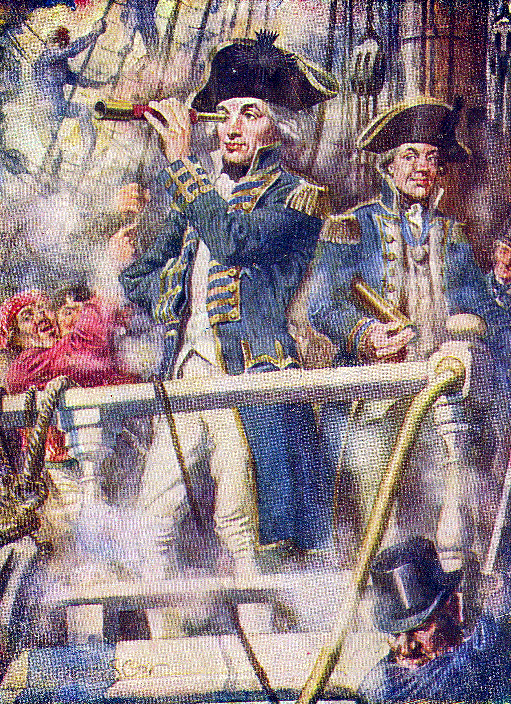
Now most equipment manufacturers and distributors are not major FCC licensees and need not fear the RKO case precedent. But in theory, FCC has lots of remedies to enforce its rules from fines to requests for court injunctions and equipment seizures. It appears that FCC continues to follow the example of Lord Nelson who raised his telescope to his blind eye during the Battle of Copenhagen so that he would not see an order he disagreed with.

It appears that FCC avoided making a finding on the XM and Sirius allegations until their merger made it impossible to ignore. Then FCC signed consent orders with XM and Sirius obligating them to make "voluntary payments" to the Treasury of $17,394,375 and $2,200,000, respectfully. One wonders if this would ever had been resolved had not the merger been forcing the issue?

More recently, FCC has announced a "citation" to The Spy Store, Inc., dated 7/31/09. This firm was selling a GPS jammer! While the ads have disappeared, a trace of them available through Google indicates the marketing pitch was "Our GPS Blocker protects you from GPS vehicle trackers!" While some cheating spouses might want such a unit to enable their liaison travel in the family car, another class of users for such technology would be criminal trying to frustrate policy surveillance.

In any case, it is hard to imagine a more clearly illegal as well as antisocial product!
So what did FCC do about it? Below is a calendar of events derived from the FCC citation:

Chronology of Spy Store/GPS Jammer Enforcement Case (File No. EB-08-SE-602)
(Click on picture for larger view)

It took FCC more than 13 months to realize these devices were being sold, despite a large web presence by the firm and multiple retail stores. One of these is close to the former FCC building at 1919 M St., NW and a casual visitor could quickly realize the equipment not meeting FCC rules were being sold. Then it took 5 months more before FCC sent a Letter of Inquiry to the firm. 5 months later, FCC closed the case with a citation threatening fines if there were repeated occurrences. (Now it is possible FCC acted slowly in this instance because another law enforcement agency with a parallel investigation asked them to do so. I doubt it based on other instances, but it is possible.)

I have dealt in the past with NTIA and IRAC and continue to deal with them on issues of mutual interest. They generally do not fully trust FCC to keep its word on spectrum sharing and mutual interference issues and this type of slow enforcement motion on a band of great importance to them is likely to rejustify their reluctance to share spectrum with FCC regulatees on reasonable terms. Since about 2/3 of the spectrum is either exclusive federal government or shared, this could have a huge impact on FCC regulatees seeking more sharing of generally lightly used federal spectrum.

NAB and MSTV repeatedly stated in Docket 04-186 (TV whitespace) comments that they think FCC will not enforce any whitespace sharing rules adopted. (This is is ironic since a key player in one of these organizations is an FCC veteran who took an active role in discouraging marketing enforcement while at FCC.)

The likely cause of the delay in this enforcement case is probably the micromanagement style of the previous chairman. Senior FCC staff were afraid to take any action, even action for which they had legally delegated authority, without a go ahead from the Chairman's Office, which, of course, was snowed under by other micromanagement issues. There are signals that the new team is trying to clarify these issues and what managers can do without direct approval.

Meanwhile, outsiders can not demand an accounting of the delays in this type of enforcement case. But I hope the 8th Floor and oversight committees do ask the staff to explain how this happened and prevent future occurrences so FCC rule enforcement becomes credible and all policy options can be considered.
==========

A observation on the FCC citation. It starts,
"This is an official CITATION, issued pursuant to Section 503(b)(5) of the Communications Act of 1934, as amended (“Act”), to The Spy Store, Inc. (“Spy Store”) for marketing in the United States unauthorized
radio frequency devices in violation of Section 302(b) of the Act,2and Sections 2.803 and 15.205(a) of the Commission’s Rules (“Rules”), and importing radio frequency devices without filing FCC Form 740 (or the electronic equivalent) with the United States Customs and Border Patrol in violation of Section 2.1203 of the Rules." (Emphasis added.)
It appears that the writer thought CBP stands for "Customs and Border Patrol". Since the 9/11 reforms, U.S. Customs has actually been replaced with "U.S. Customs and Border Protection" = CBP.

Thursday, August 06, 2009

And Now There are 5


For the first time since Inauguration Day there are now 5 commissioners at FCC with the swearing in of Comm Clyburn on August 3.

Comm. Clyburn and Attwell have not publicly announced there staffs yet so maybe things are not fully up to speed.

But hopefully the Commission can start attacking the spectrum policy backlog while working on new issues also.

UPDATE

On 8/7/09 Comm. Baker announced:
Erin A. McGrath will serve as Acting Legal Advisor for wireless, international, and public safety issues. Ms. McGrath most recently served as an Assistant Division Chief in the Wireless Telecommunications Bureau’s Mobility Division, where she managed and was the lead attorney for transactions and post-auction licensing matters. Prior to her position in the Mobility Division, she was an attorney in the Wireless Telecommunications Bureau’s Spectrum and Competition Policy Division and Commercial Wireless Division. Ms. McGrath received her B.A. from the University of Pennsylvania and her J.D. from the Benjamin N. Cardozo School of Law.
Later on August 7, Comm. Clyburn announced her initial staff appointments:
Renée Roland Crittendon will serve as Chief of Staff and Senior Legal Advisor. In addition to her duties as chief of staff and senior legal advisor, Ms. Crittendon will focus on spectrum, international and public safety matters. Ms. Crittendon has been at the FCC for eight years. She was recently named by Chairman Genachowski as a Deputy Chief of the Wireless Telecommunications Bureau. Prior to that appointment, she served as Chief of Staff and Senior Legal Advisor in the Office of Commissioner Jonathan S. Adelstein where she was responsible for spectrum, broadband, international and public safety issues.

Before joining the Commissioner’s office in 2007, Ms. Crittendon served as Deputy Bureau Chief in the Wireline Competition Bureau. Prior to that, she was Chief of the Wireline Bureau’s Competition Policy Division. Ms. Crittendon also served as Associate Division Chief of the Mobility Division of the Wireless Telecommunications Bureau. Before joining the Commission, Ms. Crittendon served as Deputy Chief Counsel –Telecommunications for Prism Communication Services, Inc, and was in private practice for several years with a Washington, D.C. law firm specializing in media, wireline and satellite issues. Ms. Crittendon received her law degree from the George Washington University National Law Center and received her undergraduate degree in Economics from Georgetown University where she is a George F. Baker Scholar alumnus and Trustee.

Tuesday, August 04, 2009


Om Malik

The GigaOM Interview:
FCC Chairman
Julius Genachowski
on
Mobile, Broadband, iPhone & Innovation


Oddly Chmn. Genachowski granted his first interview on technical policy to the politically connected Om Malik's GigaOM not SpectrumTalk. We are a little insulted, but we will survive. With the bounds of "fair use", here are some tidbits from the interview:

...this commission will be relentlessly focused on competition, consumers, innovation and investment.

...

I have nothing against lawyers — I used to be a lawyer and the FCC needs lawyers — but I’m convinced that for the agency to succeed it is equally important that the FCC to have great engineers, strong economists and people with entrepreneurial backgrounds to be sitting and talking around the tables at the FCC and talking about the kinds of policies will promote the (FCC) objectives I’ve spoken about so far.

...

If you look at the kinds of people we’re bringing in, you will see the mix of backgrounds. There’s a for-hire sign that’s open to innovators and engineers and entrepreneurs who want to be part of the conversation at the FCC.

...

On a high level, I think we need, one, to explore ways to get more spectrum into the market. Secondly, we need to identify ways that we can help drive more efficient uses of spectrum (software, cognitive radio). Third, we need to think big about creative uses of spectrum, creative ways to allocate spectrum.
Subscribe in a reader